

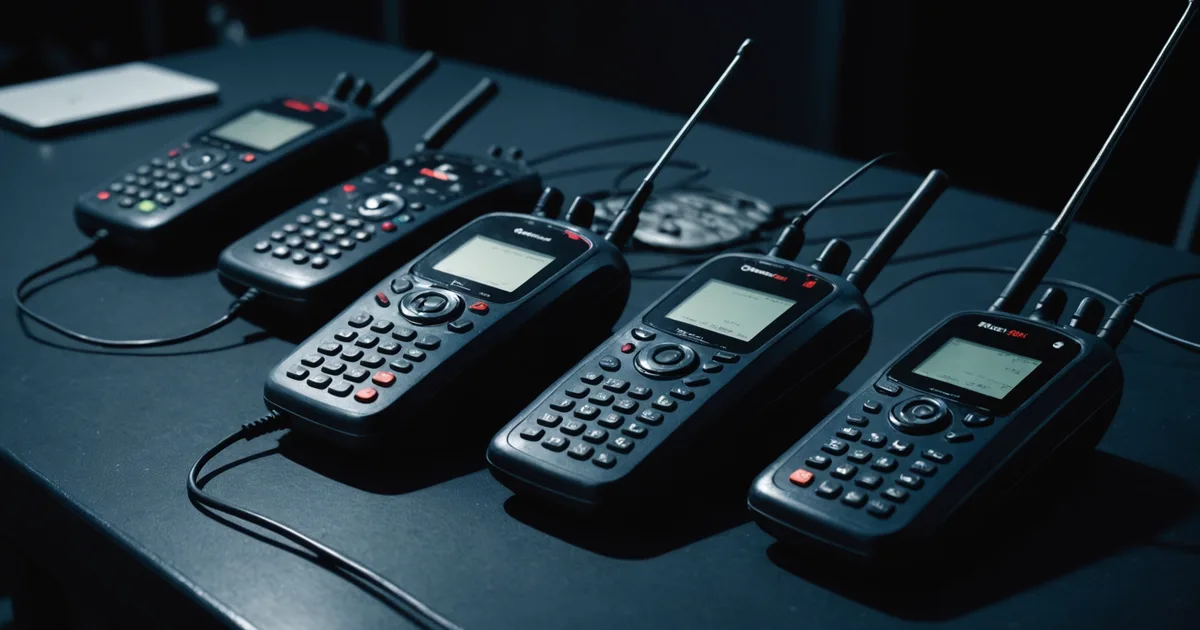
Multi-team emergency coordination can lose pace before command realises its picture is stale. A regional civil emergency planning team in the UK Midlands used four operational units in a simulated multi-point industrial incident. At the 45-minute mark, controllers introduced a partial radio failure affecting two of the four units. Within 12 minutes, the incident commander was using a picture three operational cycles out of date for those units, without knowing it. Resource allocation continued against that stale picture.
The structure of the coordination gap
Multi-team emergency response relies on a shared operational picture. Each unit has an accurate view of its own position: what is on the ground, what it has deployed, and the conditions around it. The incident commander at the command post sees the combined picture only as clearly as unit reports allow. As that flow degrades, the command picture separates from ground truth.
How quickly that separation grows depends on the incident's pace and the severity of the communications failure. A static incident, with units holding position, may tolerate poor communication for some time. A developing incident involving repositioning and redeployment cannot. The same radio failure can be inconvenient in one scenario and operationally dangerous in another.
That is the coordination gap: the distance between individual unit knowledge and command knowledge, widening fastest when close coordination is most necessary. It is built into multi-team response, not caused by an individual's poor performance. Everyone can perform correctly while the gap expands.
Why radio failures specifically
Radio failure in emergency response rarely means communication stops completely. More often, it is degraded: some transmissions arrive and others do not; some frequencies work while others are blocked; some units reach the relay and others cannot. This partial failure is harder than a complete outage because command cannot tell reliably which units remain reachable or what information is missing.
Complete radio failure has a defined response: use the pre-planned communication redundancy plan, establish physical liaison officers, and move to a backup frequency. Partial failure is unclear. Delivered messages suggest that communications still work, while missed messages leave unseen gaps. The incident commander may not realise that the three transmissions received in the last ten minutes represent only half of what the field sent.
Radio traffic during operations is also difficult to transcribe or log in real time. A transmissions log may exist, but its operational meaning, which unit is where, what resources are deployed, and the status of each incident point, must be maintained manually in the command post picture. That picture is only as current as its latest update. Degraded radio communication makes those updates less frequent and less complete than needed.
What an aged command post picture looks like
Post-exercise reviews with incident commanders show a recurring pattern: they underestimate how old their operational picture has become during communications degradation. They know some transmissions were unclear or incomplete, but reduce confidence in the picture by less than the data's actual age warrants. It still looks like a picture, with positions, resources, and incident status labels. That some information is 20 minutes old rather than 2 minutes old is not visually obvious.
This reflects a structural limit of command displays, not a commander failing. A display showing resource positions updated two minutes ago looks the same as one showing positions updated 20 minutes ago unless confirmation time is visible. The commander must keep each element's currency in mind, adding cognitive burden when the incident is already demanding significant attention.
Where decision support helps, and where it cannot
The straightforward technology response is digital tracking in real time, automated status updates, and integrated communications logs. These are useful where they can be deployed and maintained reliably. A permanent, networked command post differs from a mobile command unit at a dynamic outdoor incident. Even with extensive tracking, it may fail alongside the radio because both depend on the same physical setting and often the same power and communications infrastructure.
The useful technology response targets visibility, not simply data volume. The question is which information remains current and which has aged. A decision support flag stating, "this unit's last confirmed status update was 18 minutes ago, before the road closure that changed the incident geography," gives the commander a clear prompt to restore contact with that unit. Rather than relying on mental estimates of information age, the team sees the staleness directly.
The coordination gap in industrial emergency response
The same coordination gap appears in industrial emergency response, although the physical scale differs. A COMAH site incident involving several response teams, the site emergency response team, the fire service, and hazardous-materials contractors creates the same multi-unit coordination challenge within the same radio constraints.
Industrial emergency response has one possible advantage: the process plant continuously produces data that can partly reconstruct events without radio reports. Sensor readings, valve positions, pump states, and flow rates come from the DCS whether or not ground teams can transmit. An incident commander with access to this process data retains a partial plant-level picture even when communication with ground teams deteriorates.
This is where Offset operates in industrial emergency scenarios: it synthesizes available process data streams to maintain the most current possible view of process conditions, identifies where that view is incomplete, and produces a prioritized recommendation based on process state. The recommendation uses process instrument readings, not the latest ground-team report. Ground-team information adds to the process picture but does not replace it. As radio communication degrades, the process data layer continues updating independently.
After the exercise: what the review found
In the Midlands exercise, the post-exercise review found that the incident commander made two resource allocation decisions during the radio degradation period that, in a live incident, would have sent resources to a location already adequately covered, while a developing situation elsewhere received none. Given the information available, neither decision was wrong. That information was simply incomplete in ways the commander could not see.
The review did not place radio equipment first, although improving it remained on the list. Its main recommendation was to strengthen command post protocols for tracking information age: when each unit's status was last confirmed, what changed in the incident since then, and which unit's picture is oldest and most urgently needs an update. The process question came before the technology question, which is usually the right sequence. Decision support helps only when the command team understands its limits and stays aware of the gaps in its information picture.